Workplace Compliance with Environmental Monitoring
The work environment
has to be documented.
Not just monitored.
Regulations rest on records, not intent. Continuous data, audit-ready reports and per-device traceability. From monitoring to compliance, continuously.
← Back to SolutionsCompliance is built on data,
not on words.
A large share of findings come from environmental conditions that were never measured, not because the problem didn't exist, but because no one recorded that it didn't.
Ergonomics standards call for adequate temperature, humidity and illuminance. Unhealthy-work standards define exposure limits for harmful agents. Newer occupational health frameworks recognize environmental factors as a psychosocial risk.
Risk management programs require continuous mapping. Labor inspectors require history. Labor-related disputes require records documenting the control. Without data, the company has no basis to respond.
Labor liability
Claims for hazard pay can cost, on average, many times the price of a monitoring system. The data is a key supporting element in a dispute.
Fines and shutdowns
Labor inspections can fine or shut down environments that cannot demonstrate continuous control of working conditions.
Occupational health & mental wellbeing
The growing duty to manage psychosocial risks requires identifying and controlling environmental factors that affect the wellbeing and mental health of workers.
Risk programs without evidence
A risk management program requires documented monitoring. A manual spreadsheet or periodic inspection does not stand up to a formal audit.
Four obligations.
One evidence platform.
Each requirement has its own parameter, its own buyer and its own specific risk. PLEXOR covers the environmental parameters with integrated hardware and platform.
Psychosocial Risk Management
Increasingly required, occupational health frameworks now ask companies to identify and manage psychosocial risk factors, including inadequate environmental conditions that affect mental health, cognition and wellbeing.
Unhealthy Activities & Operations
Defines tolerance limits for exposure to physical, chemical and biological agents. Heat, cold, noise and toxic gases must be measured regularly and documented.
Ergonomics, Environmental Conditions
Requires work environments to offer adequate temperature, relative humidity and air velocity, plus illuminance suited to the activity performed (ISO 7730 thermal comfort).
Risk Management Program
A modern risk management program requires a risk inventory with continuous monitoring, a documented action plan and evidence for labor audits.
Continuous monitoring.
Permanent evidence.
In-house hardware with ISO 9001 manufacturing, connected to a native IoT platform, delivering continuous data, configurable alerts and audit-ready reports, logging every offline period.
Generated by the platform with a unique device identifier, company data, time-series charts and regulatory ranges. Audit-ready with one click.
Continuous data retention, exportable at any time as PDF or CSV. Labor disputes require retroactive history: here it exists.
Configurable by threshold, envelope and time out of range. Email, webhook and REST API sent to the person in charge the moment a parameter goes out of compliance (SMS as an add-on).
Every reading carries the ID of the device that generated it. In an audit, you know exactly which sensor, in which location, on which date recorded each value.
A 3-level hierarchy on the platform: company → sites → locations. Ideal for mid-sized and large companies with multiple plants or monitored floors.
The entire device fleet always on the latest version, with no service visit. New regulatory ranges are added via firmware at no extra cost.
Deployed in days.
Evidence from the first reading.
Installation
PLX devices installed in the mapped environments. Plug-and-play, no construction, no structural cabling.
Configuration
Regulatory ranges configured per requirement. Alerts defined by person in charge and by location.
Monitoring
Data sent to the platform continuously. Live dashboard. Automatic alerts whenever needed.
Documentation
Reports generated with one click. Exportable history. Audits, risk programs and support for the defense.
The right product
for each obligation.
Three models for complete coverage of thermal comfort, hazard exposure and ergonomics. Same platform, same history, same traceability.
- eCO₂ in ppm, air-quality trends and peaks
- Automatic compliance reports, audit-ready
- Alerts configurable by variable and by device
- History of up to 5 years, exportable as PDF/CSV
- Supports psychosocial risk data on environmental factors
The hardware collects.
The platform documents.
Developed in-house, the PLEXOR platform turns readings into records, with history, reports and traceability that support audits, risk programs and the work of qualified professionals. Legal interpretation and classification (technical report, risk program, expert assessment) are the responsibility of a qualified professional.
Compliance report in one click
PDF with company data, device ID, time-series charts and regulatory ranges. Ready to hand to the auditor or the legal expert.
History of up to 5 years
Continuous retention, logging every offline period. Labor disputes often require 2 to 5 years of history, here it exists and is exportable.
Alerts before the problem
Email, webhook and REST API when a parameter leaves its range (SMS as an add-on). Configurable by variable, by location and by alert type, threshold, envelope or continuous time.
Multi-plant with segregated access
Management by entity: company → site → location. Each person in charge sees only what is their responsibility.
Secure infrastructure
AWS on a private network, HTTPS + CloudFlare + TLS 1.3, encrypted database with replica set. 2FA available.
OTA, fleet always up to date
New regulations are added via remote firmware update, with no service visit or extra cost.
What it costs not to monitor
is bigger than it seems.
❌ Without monitoring
- 💸 Hazard pay on payroll, accumulated for years without being contested
- ⚖️ Labor dispute with no records documenting the control, an adverse ruling almost certain
- 🚨 Fines from labor inspections, per employee, per day
- 📋 Incomplete risk program, company exposed in insurance and certification audits
- 🧠 Psychosocial risk duties unmet, a newer obligation, a growing risk still lightly enforced, but with a clear upward trend
- ⏱ HR and Legal hours spent responding to findings, an invisible opportunity cost
✓ With PLEXOR
- 📊 Compliance report generated automatically, zero manual hours
- 🛡️ History of up to 5 years exportable, documented defense in any dispute
- 🔔 Alert before the problem, corrective action before the finding, not after
- 🏢 All sites on one platform, a consolidated view for HR and OH&S
- ✅ Risk program with evidence, data ready for formal audits and certifications
- 💡 Measurable ROI, cost of the solution vs. the first hazard-pay claim contested
Where the environment
is a legal obligation.
Any company with employees has a workplace-compliance obligation. These are the sectors with the highest exposure and most urgent need for monitoring.
Frequently asked
questions.
Is environmental monitoring required for occupational thermal comfort?
International standards such as ISO 7730 (thermal comfort, PMV/PPD) and heat-stress criteria (WBGT) call for adequate temperature, humidity and lighting at workstations. While most standards do not specify equipment, continuous monitoring helps document the environmental conditions and support the compliance analysis, aiding the response to audits and inspections.
What needs to be monitored for an occupational risk management program?
For workplace compliance and risk management, the main environmental parameters are temperature, relative humidity, illuminance and indoor air quality (IAQ/eCO₂). The PLX-A500 monitors all of them simultaneously, with an auditable history of up to 5 years on the platform.
How does monitoring work without invading employee privacy?
PLEXOR sensors monitor the environment, temperature, humidity, illuminance and air quality, not people. There are no cameras, no movement tracking and no personal data collection. The data is environmental and anonymous by nature.
See compliance happen.
The dashboard shows the percentage of time within the thermal-comfort range, the heat index and the history, the evidence ready for the auditor, without building a spreadsheet.
See the platform →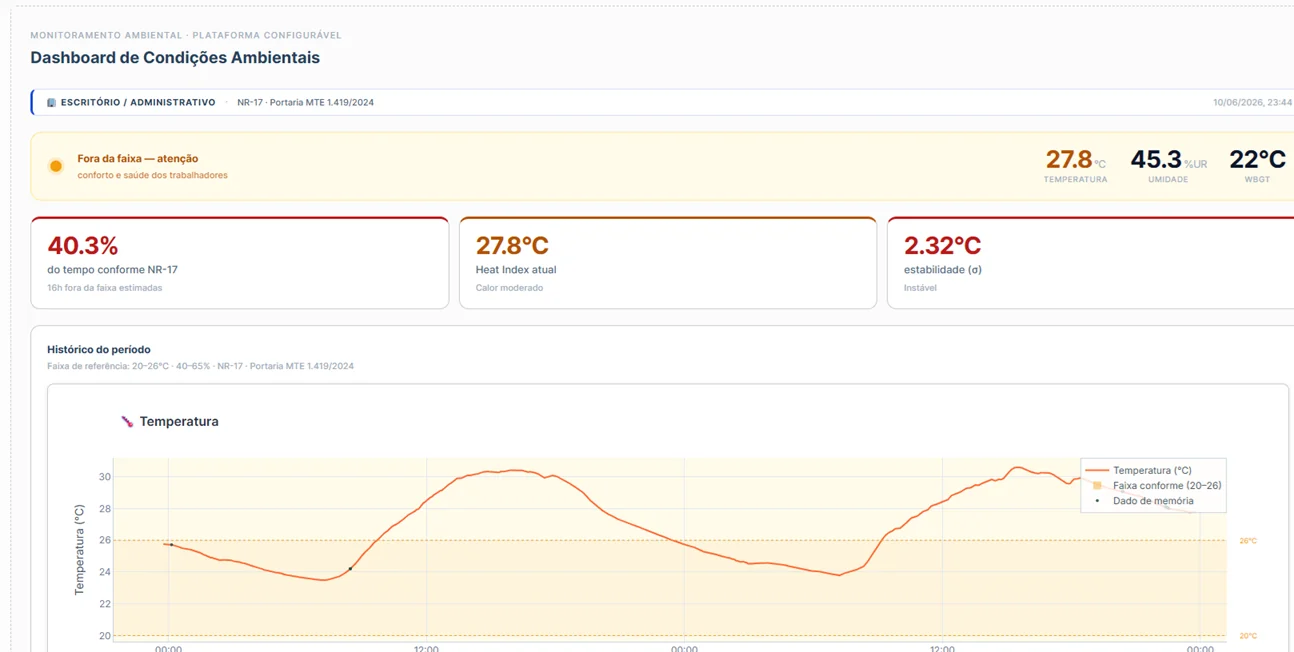
Document your compliance
before it is
questioned.
Talk to a PLEXOR specialist. In 20 minutes you see the device running and the platform generating the report, live.