Critical Infrastructure Monitoring
Catch an environmental failure
in a critical environment
before the alert.
In critical infrastructure, the cost of not monitoring is measured in hours of downtime, burned-out equipment or compromised clinical processes. Continuous monitoring with immediate alerts, before the problem becomes an incident.
← Back to SolutionsIn critical infrastructure,
the problem gives no warning
before it happens.
A data center with elevated temperature for hours brings down servers, corrupts data and triggers an SLA breach with clients. A telecom equipment room without monitoring can suffer an HVAC failure that is only discovered when the operation goes down.
The critical environment fails silently, and by the time the failure becomes visible, the impact is already operational, financial and reputational. Continuous monitoring is not a nice-to-have: it is what separates a resilient operation from a fragile one.
For hospitals, an environmental failure can compromise clinical processes. For museums, it can accelerate the deterioration of irreplaceable collections. For everyone, an alert after the fact is already too late.
Downtime from HVAC failure
An overheated server shuts down for thermal protection. Every hour of IT downtime has a measurable, and avoidable, cost when you have an early alert.
Compromised clinical processes
CSSD, hospital pharmacy and operating rooms have healthcare regulatory requirements for environmental control. A documented failure generates non-conformity and patient risk.
Irreversible damage to collections
Temperature and humidity outside the ideal range accelerate the degradation of artworks, documents and artifacts, damage that cannot be undone.
Network failure in the NOC
Network operations rooms with elevated temperature degrade active equipment and increase the failure rate, impacting the service quality of the entire operation.
Every critical environment
has its non-negotiable range.
From the server rack to the artwork storage room, every space has parameters that, out of range, generate real and immediate impact.
Data Centers and IT Rooms
Temperature and humidity of server rooms and racks, with an alert before thermal shutdown. Monitoring without relying on local IT infrastructure.
Telecom and NOC
Equipment rooms of carriers, providers and network operations centers. High criticality, long recurring contracts, technical procurement process.
Hospitals and Clinics
CSSD, hospital pharmacy, operating rooms and ICUs have healthcare regulatory requirements for environmental control. Monitoring with traceability for hospital accreditation.
Museums and Cultural Heritage
Collection conservation requires precise, continuous monitoring of temperature and humidity. The argument is preservation, not compliance. Maximum loyalty, high brand visibility.
Facilities and Buildings
Technical rooms, machine rooms, UPS centers and generators in corporate buildings. Monitoring that covers what building automation does not reach.
Archives and Document Collections
Libraries, registry offices, historical archives and document collections, monitored temperature and humidity for the preservation of irreplaceable physical documents.
Alert before the incident.
Evidence after.
Continuous monitoring independent of local infrastructure, with real-time alerts, an auditable history and a platform that centralizes multiple environments in a single view.
Email, webhook and REST API the moment a parameter goes out of the critical range (SMS as an add-on). Not after the server has shut down, but before it has to shut down for thermal protection.
Dedicated Wi-Fi, without relying on the client's corporate network. In environments where IT does not want devices on the main network, the PLX operates on a parallel Wi-Fi network.
Every period a device is offline is logged on the platform. Essential to prove monitoring continuity in accreditations, SLAs and audits.
Hierarchical management of multiple sites, data center, technical rooms and facilities in a single panel, with segregated access by owner and by site.
Exportable at any time in PDF or CSV. For hospital accreditations, SLAs with data center clients and cultural heritage audits.
AWS on a private network, HTTPS + CloudFlare + TLS 1.3, an encrypted database with a replica set and two-factor authentication. Critical environment data, protected.
Deployed with no integration
into local IT.
Installation
PLX devices installed at the critical points of the environment. Plug-and-play, with no construction or integration with the local network.
Configuration
Critical ranges defined per environment. Alerts configured by owner, technician, facilities or NOC.
Monitoring
Real-time dashboard. Immediate alert by email, webhook and REST API (SMS as an add-on), regardless of the time and wherever the owner is.
Evidence
Exportable history for SLA, accreditation and audit. Offtime logged to prove the continuity of monitoring.
The right sensor
for every critical space.
The Environmental family for enclosed spaces, Thermal Mapping for specific critical points, and a platform that centralizes everything.
- Continuous monitoring of temperature and humidity
- Ideal for server rooms, NOC and technical rooms
- Alert by threshold and time out of range
- Dedicated Wi-Fi, without relying on the local network
- Up to 20h backup battery, uninterrupted monitoring
- Light level 0–10,000 lux, for collection conservation
- T° and humidity with a high-precision internal sensor
- Alerts by variable, threshold and envelope
- History of up to 5 years exportable for audit
- Per-device traceability for accreditations
- PT100 probe on the equipment or critical surface
- Ideal for hospital CSSD and in-house pharmacy
- Calibration certificate available, healthcare regulatory and accreditation
- Report with device ID, full traceability
- Calibration management integrated into the platform
Central visibility.
Alerts at the edge.
All critical environments in a single panel, with alerts that reach the people who need them, the moment they need them, wherever they are.
Multi-environment with segregated access
Hierarchical management of multiple sites. Each owner accesses only their environments, facilities, IT and NOC with separate views.
Immediate alert before the incident
Email, webhook and REST API at the moment of deviation (SMS as an add-on), before the environment reaches the damage range. Configurable by site, by owner and by criticality.
Offtime logged
Every offline period documented automatically. Essential for data center SLAs, hospital accreditations and facilities audits
History of up to 5 years
Exportable in PDF or CSV at any time. Proof of continuous monitoring for SLA contracts, audits and accreditation renewals.
Calibration management
Control of certificate expiry with automatic reminders, for environments that require metrologically valid traceability (hospitals, labs).
OTA, fleet always up to date
Remote firmware update for all devices, with no technical visit. The whole fleet, at any site, always on the latest version.
One hour of downtime
covers years of monitoring.
❌ Without traceability
- 🖥️Downtime from thermal failure, cost per hour of unavailability, SLA breach and reputational impact
- 🏥Hospital non-conformity, risk of losing accreditation and clinical exposure
- 🎨Irreversible damage to collections, civil liability and loss of irreplaceable heritage
- 📡Silent degradation of equipment, reduced service life with no data to prove the cause
- ⚖️SLA breach without evidence, no data, no contractual defense
✓ With PLEXOR
- 🔔Alert before the incident, corrective action before downtime
- 📅History for SLA, evidence of continuous monitoring, logging every offline period
- 📄Report for accreditation, exportable in one click, traceable per device
- 🏢Centralized multi-environment, visibility of all critical infrastructure in one panel
- 💡Clear ROI, the cost of monitoring vs. the cost of a single downtime incident
Any environment
where failure is not an option.
Frequently asked
questions.
Does monitoring keep working if the local network goes down?
Yes. PLEXOR sensors have an up to 20h backup battery and keep operating even without mains power. The platform runs on cloud infrastructure independent of the local network, so alerts and history remain accessible even during local connectivity failures.
How are alerts generated when a parameter goes out of range?
Alerts are configured by threshold (absolute value), envelope (variation over a period) or time out of range. When triggered, the platform sends notifications by email, webhook and REST API to the designated owners (SMS available as an add-on), without relying on someone actively watching the dashboard.
Can multiple environments be managed in a single view?
Yes. The PLEXOR platform centralizes all devices in a single dashboard, with views by location, group or environment type. Ideal for distributed operations, data centers across different sites, multiple floors or units in different cities.
All your environments, on one screen.
Centralized view of multiple critical points, with real-time status and an immediate alert on deviation, independent of local infrastructure.
See the platform →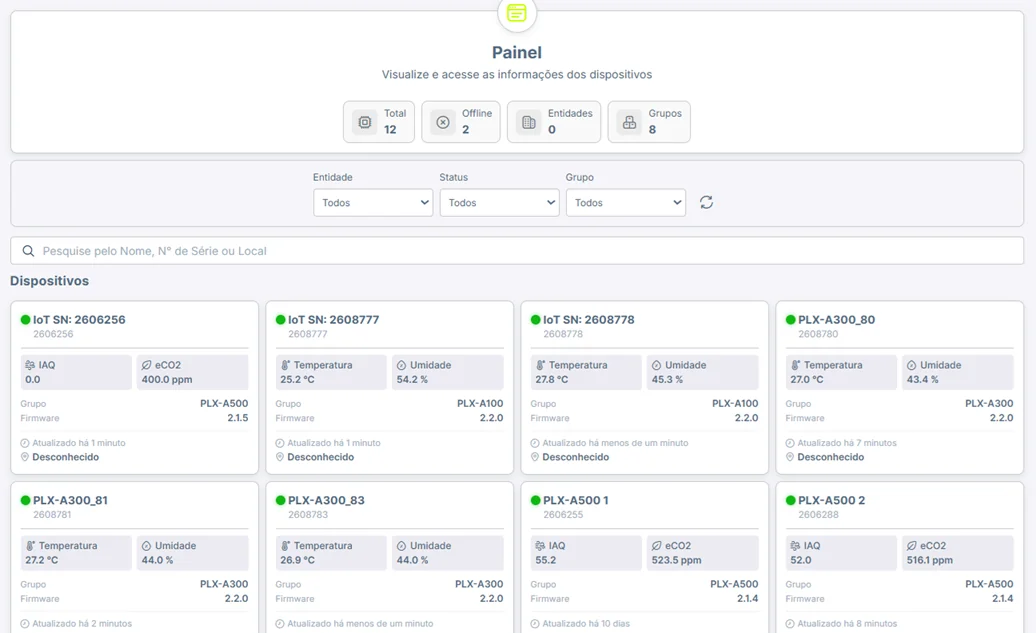
Know before the incident.
Not after.
In 20 minutes you see the device working, the alert firing in real time and the history being generated, with no slide deck.